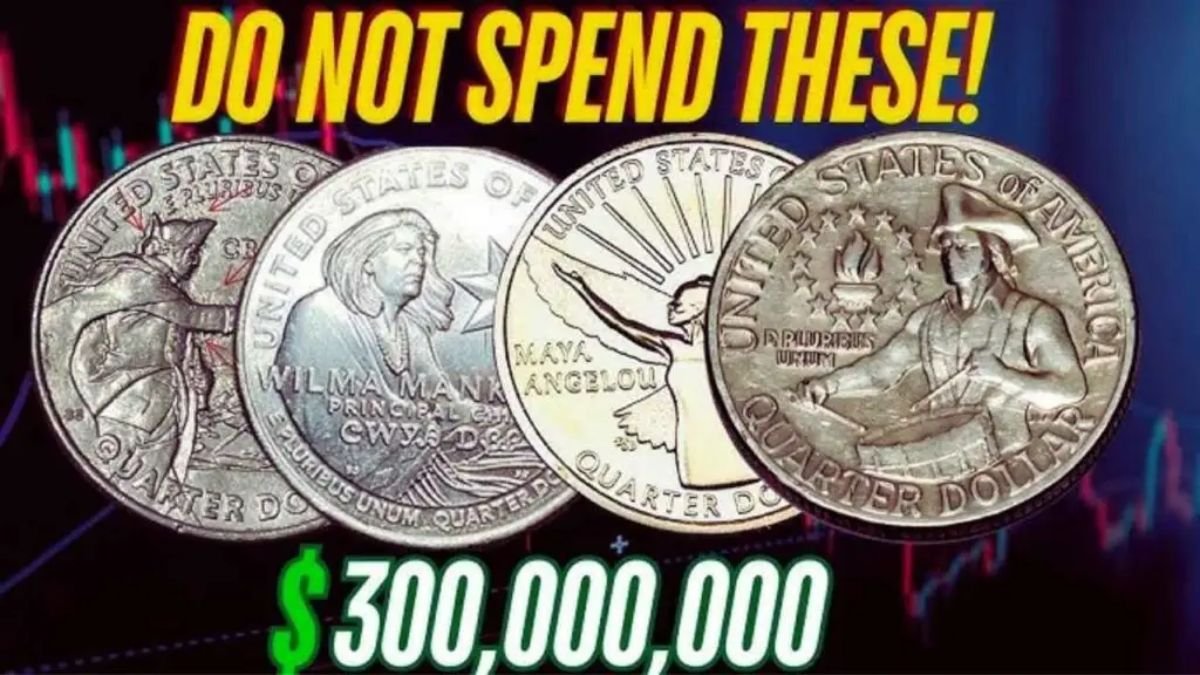
Two U.S. coins that frequently attract attention from collectors are the Sacagawea dollar and the 1976 Bicentennial quarter. Both have distinctive designs, strong historical connections, and a reputation for occasionally being worth more than their face value.
But there is a lot of misinformation online about these coins. A Sacagawea dollar may look like gold, but ordinary examples do not contain gold. Likewise, most 1976 Bicentennial quarters are not rare and are worth only their face value.
So, which one is potentially more valuable? The answer depends on the exact coin, its condition, composition, mintmark, and whether it has a recognized error or variety.
What Is the Sacagawea Dollar?
The Sacagawea dollar was introduced by the U.S. Mint in 2000. The obverse features Sacagawea carrying her infant son, Jean Baptiste, while the reverse originally showed a soaring eagle.
The coin was designed to replace the Susan B. Anthony dollar and was intended to offer Americans a new dollar coin with a distinctive appearance.
The U.S. Mint selected Sacagawea’s image following a national design process, and the coin was released into circulation in 2000.
Is the Sacagawea Dollar Actually Gold?
No.
This is one of the most common misconceptions about the coin.
The Sacagawea dollar has a golden color, but ordinary circulation coins do not contain gold. Their distinctive appearance comes from their copper-based manganese-brass outer layers.
The standard composition is approximately:
- 88.5% copper
- 6% zinc
- 3.5% manganese
- 2% nickel
Therefore, finding a shiny golden-colored Sacagawea dollar does not automatically mean you’ve found a gold coin.
Why Do Some Sacagawea Dollars Have Higher Values?
Most regular Sacagawea dollars are worth around their $1 face value.
However, certain examples can be worth substantially more because of:
- Rare mint errors
- Special varieties
- Extremely high grades
- Limited collector issues
- Unusual production characteristics
Some coins can command significant premiums when they are professionally authenticated and graded.
The important point is that the date alone does not make an ordinary Sacagawea dollar rare.
The Famous 2000-P Sacagawea Dollar
The 2000-P Sacagawea dollar is particularly interesting because of several known varieties and errors.
One of the best-known is the 2000-P Cheerios dollar, which was included in promotional Cheerios cereal boxes when the new dollar was introduced.
Some examples have distinctive reverse details that distinguish them from ordinary 2000-P dollars.
These coins can be much more valuable than normal circulation examples, but authentication is important because not every unusual-looking 2000 dollar is a Cheerios variety.
What Is the Bicentennial Quarter?
The Bicentennial quarter was created to commemorate the 200th anniversary of American independence.
Instead of the traditional eagle reverse, the coin features a colonial drummer accompanied by a torch and surrounded by stars.
The reverse also displays the dates 1776–1976.
The coin was produced during both 1975 and 1976, but all examples carry the dual 1776–1976 date. The U.S. Mint released the Bicentennial quarter in 1975 as part of the broader national anniversary program.
Are Bicentennial Quarters Rare?
Most are not.
The Mint produced enormous quantities of Bicentennial quarters for circulation. As a result, finding a 1976 quarter with the drummer design does not automatically mean you’ve discovered a rare coin.
Many ordinary circulated copper-nickel examples are worth approximately their 25-cent face value.
However, certain versions can be more desirable.
Silver Bicentennial Quarters
One important exception is the 40% silver Bicentennial quarter.
The U.S. Mint produced special silver-clad Bicentennial coins for collectors. These are different from the standard copper-nickel circulation pieces.
If your Bicentennial quarter is a special silver issue, its value can be higher than face value because of its silver content and collector demand.
The U.S. Mint specifically authorized 40% silver Bicentennial coins during the program.
Bicentennial Quarter Errors
Another category worth checking is mint errors.
Collectors may pay premiums for genuine examples featuring major errors such as:
- Off-center strikes
- Broadstrikes
- Double strikes
- Wrong planchets
- Other significant minting abnormalities
However, not every scratch, discoloration, or unusual mark represents a mint error.
Damage occurring after the coin left the Mint can create appearances that resemble errors. Professional authentication is recommended before assuming an unusual coin is extremely valuable.
Sacagawea Dollar vs. Bicentennial Quarter
Here’s a simple comparison:
| Feature | Sacagawea Dollar | Bicentennial Quarter |
|---|---|---|
| Face value | $1 | $0.25 |
| Introduced | 2000 | 1975–1976 |
| Main historical theme | Sacagawea and Lewis & Clark era | U.S. Bicentennial |
| Color | Golden-colored | Silver-colored |
| Ordinary composition | Copper-based clad | Copper-nickel clad |
| Contains gold? | No | No |
| Special silver versions? | Not ordinary circulation coins | Yes |
| Common examples | Usually near face value | Usually near face value |
| Potential premium | Errors, varieties, high grades | Silver issues, errors, high grades |
Which Coin Is More Valuable?
There isn’t a single answer.
An ordinary Sacagawea dollar is generally worth about $1, while an ordinary Bicentennial quarter is generally worth about 25 cents.
But a rare Sacagawea variety could be worth substantially more than a normal Bicentennial quarter.
Likewise, a rare silver Bicentennial quarter, major mint error, or exceptional high-grade example could be worth considerably more than a standard Sacagawea dollar.
The specific coin matters much more than the denomination.
How to Check Your Sacagawea Dollar
If you have a golden-colored dollar coin, follow these steps:
1. Check the Date
Look for the year on the coin.
2. Identify the Mintmark
Determine where the coin was produced.
3. Inspect the Reverse
Early Sacagawea dollars feature the eagle reverse, while later years feature changing reverse designs as part of the Native American Dollar program.
4. Look for Varieties
Pay attention to unusual details, particularly on early issues.
5. Check the Condition
An uncirculated coin with strong surfaces and minimal marks can be more desirable than a heavily circulated example.
6. Avoid Cleaning
Never polish or chemically clean a potentially valuable coin. Cleaning can damage the original surfaces and reduce collector appeal.
How to Check Your Bicentennial Quarter
If you have a 1776–1976 quarter, look for several things.
Check the mintmark:
Depending on the issue, you may find a P, D, or S mintmark.
Check the composition:
Special 40% silver Bicentennial coins were produced for collectors.
Check the condition:
Uncirculated and proof examples can be more desirable.
Look for errors:
Major, authenticated mint errors can bring significant premiums.
Examine the edge:
The edge and overall appearance can provide clues about the coin’s composition.
Don’t Trust Every “Rare Coin” Price Online
One of the biggest problems with modern coin collecting is misleading online valuation information.
You may see listings claiming that an ordinary Sacagawea dollar or Bicentennial quarter is worth thousands of dollars.
An online listing price is not the same as an actual selling price.
A coin advertised for $10,000 does not mean someone is willing to pay $10,000 for it.
Before assigning a high value, check:
- Professional auction records
- PCGS or NGC information
- Certified grades
- Recognized varieties
- Actual completed sales
- Coin authenticity
Could Your Coin Be Worth Thousands?
It is possible for certain rare U.S. coins to bring very high prices, but this is the exception rather than the rule.
For example, the U.S. Mint has documented unusual Sacagawea-related pieces, including special 22-karat gold examples made for a 1999 presentation and spaceflight project. These are completely different from the ordinary golden-colored Sacagawea dollars found in circulation.
Similarly, exceptional Bicentennial quarters with major errors, special compositions, or extraordinary grades can command premiums.
That doesn’t mean every 1976 quarter or Sacagawea dollar is a hidden fortune.
Which One Should Collectors Keep?
Both can be worth keeping.
The Sacagawea dollar is interesting because it represents a major change in U.S. dollar coin design and continues into the Native American Dollar series.
The Bicentennial quarter is historically significant because it commemorates America’s 200th anniversary and has one of the most recognizable quarter designs of the modern era.
Even common examples can make enjoyable additions to a collection.
Final Verdict
When comparing a Sacagawea dollar with a 1976 Bicentennial quarter, neither coin is automatically rare simply because of its appearance or historical design.
The Sacagawea dollar is golden-colored but does not contain gold, while ordinary Bicentennial quarters are generally copper-nickel clad. Special 40% silver Bicentennial issues are an important exception.
Most circulated examples of both coins are worth close to face value.
The real value comes from rarity, mint errors, special composition, varieties, condition and authentication.
So if you have one of these coins, don’t judge its value by color alone. Check the date, mintmark, composition and condition before deciding whether you’ve found something truly collectible.