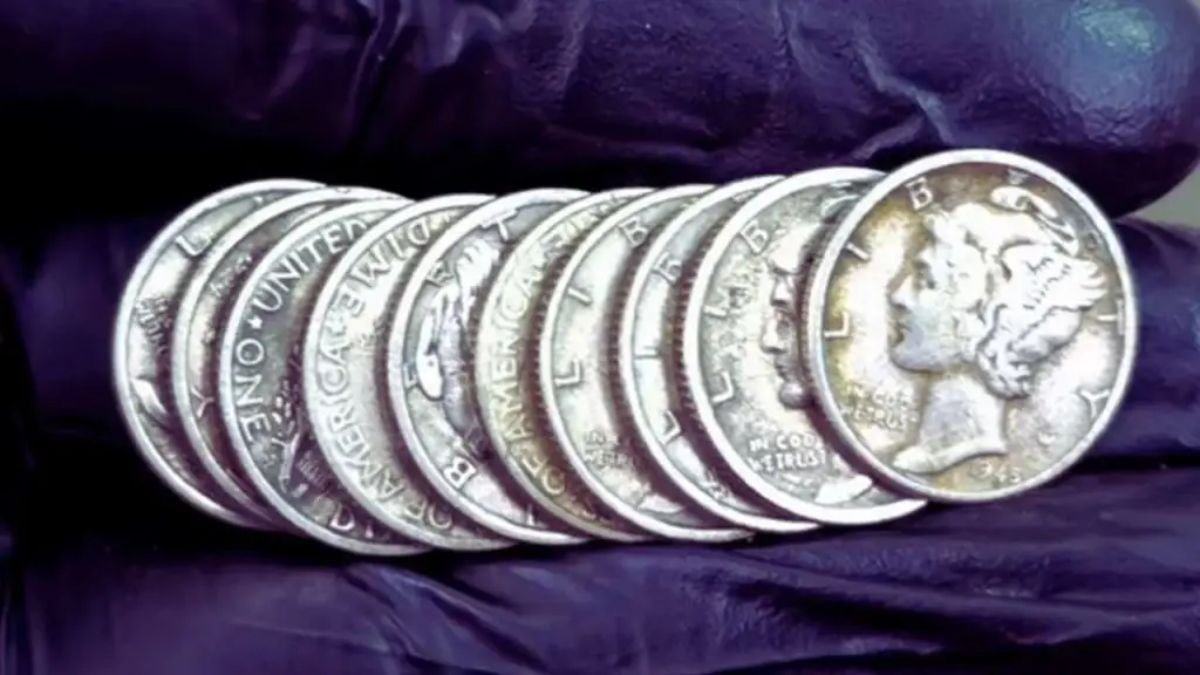
A Mercury Dime may look like an ordinary 10-cent coin, but some rare examples have sold for hundreds of thousands of dollars.
The United States Mint produced Mercury Dimes from 1916 through 1945, and certain dates, mintmarks, and varieties are now among the most desirable coins in American numismatics. While most Mercury Dimes are not worth a fortune, a few rare pieces can command extraordinary prices at auction.
If you have old silver dimes tucked away in a collection, inherited coin box, or family drawer, check the date and mintmark before assuming they’re only worth their silver value.
Here are five of the most valuable Mercury Dimes ever recorded.
1. 1916-D Mercury Dime — $207,000
The 1916-D Mercury Dime is widely considered the key date of the entire series.
Only about 264,000 were struck at the Denver Mint, making it one of the lowest-mintage regular-issue Mercury Dimes. The tiny mintage, combined with strong collector demand, has made the 1916-D one of America’s most famous rare dimes.
According to PCGS auction records, a high-grade MS65 example sold for $207,000.
The D mintmark can be found on the reverse, near the bottom-left area of the coin.
Even heavily circulated examples can be valuable compared with common Mercury Dimes, while exceptional uncirculated pieces can reach six figures.
What to check: Look for the 1916 date and D mintmark. Because counterfeit 1916-D Mercury Dimes are common, authentication is extremely important.
2. 1938-S Mercury Dime — $364,250
The 1938-S Mercury Dime is a fascinating example of how condition can dramatically affect a coin’s value.
Although the 1938-S isn’t as famous as the 1916-D, superb examples with exceptional preservation and eye appeal can bring enormous prices.
PCGS records an auction high of $364,250 for a 1938-S Mercury Dime in high-grade Mint State condition.
This demonstrates an important lesson for collectors: rarity isn’t always determined simply by mintage. Some coins are relatively available in circulated grades but become extremely scarce in top condition.
What to check: Look for the 1938 date and S mintmark on the reverse. Examine the coin carefully for original luster, strong details, and minimal marks.
3. 1931-S Mercury Dime — $270,250
The 1931-S Mercury Dime is another major rarity that can be worth a fortune in exceptional condition.
PCGS reports an auction record of $270,250 for a high-grade example.
The 1931-S is especially interesting because it comes from a period when relatively few Mercury Dimes were produced. Collectors seeking a complete set consider this one of the important dates to find.
While an average circulated example won’t necessarily approach the six-figure prices seen at auction, premium-quality specimens can be extraordinarily valuable.
What to check: Look for the 1931-S combination and pay close attention to the coin’s condition.
4. 1918-D Mercury Dime — $182,125
The 1918-D Mercury Dime is another early Denver issue that has produced spectacular auction results.
PCGS records a top auction price of $182,125 for an MS-grade example.
Early Denver Mercury Dimes can be difficult to find in exceptional condition, which helps explain why the finest surviving examples can sell for far more than their face value.
For collectors, the combination of an early date, Denver mintmark, and superior preservation makes the 1918-D particularly desirable.
What to check: Find the D mintmark on the reverse and inspect the coin for wear, scratches, and overall sharpness.
5. 1919-D Mercury Dime — $156,000
Rounding out the list is the 1919-D Mercury Dime, another scarce early Denver issue.
PCGS auction records show a high of $156,000 for a high-grade example.
The 1919-D is one of those coins that illustrates why collectors shouldn’t overlook older Mercury Dimes simply because they appear worn. Even coins from the same date can have dramatically different values depending on grade and preservation.
What to check: Look for the 1919 date and D mintmark, then examine the coin’s condition carefully.
What Makes a Mercury Dime Valuable?
Not every old Mercury Dime is worth thousands of dollars. Value depends on several factors, including:
- Date and mintmark
- Rarity
- Condition and grade
- Strike quality
- Full Bands designation
- Original surfaces and luster
- Collector demand
Some Mercury Dimes that appear ordinary in circulated condition can become extremely valuable when found in pristine Mint State condition.
The 1942/1 and 1942/1-D overdates are also important varieties. These coins show the 2 of the 1942 date struck over a 1, and PCGS identifies them as major Mercury Dime varieties. A PCGS auction record for the 1942/1 is $120,000, while the 1942/1-D has reached $73,437.50.
How to Check Your Mercury Dime
Start by turning the coin over and checking the date and mintmark. Then look at the condition of the coin and compare it with reliable coin references.
Don’t clean the coin if you think you have a rare specimen. Cleaning can permanently damage the surfaces and reduce collector value.
For potentially valuable coins—especially a 1916-D, 1931-S, 1938-S, or other major rarity—professional authentication and grading can be worthwhile.
Final Thoughts
Mercury Dimes remain some of the most fascinating silver coins in American collecting. While most examples aren’t worth a fortune, rare dates and exceptional high-grade specimens can command astonishing prices.
The 1916-D Mercury Dime, in particular, remains the coin every collector dreams of finding.
So, before you spend or sell that old silver dime, check the date and mintmark carefully. You might be holding a coin worth far more than 10 cents.